

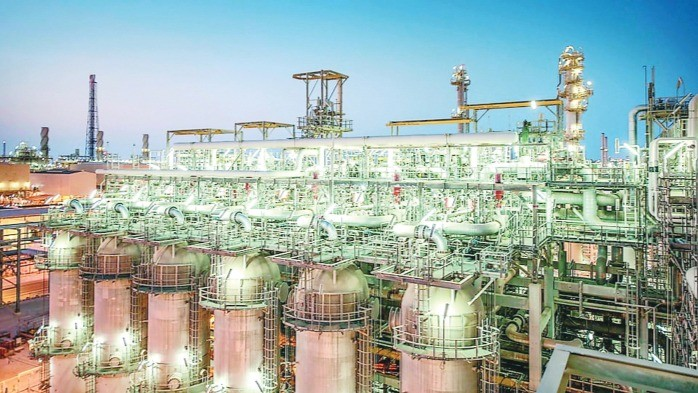
Fischer-Tropsch reactors at Shell’s Pearl Plant in Qatar
Welcome to this newsletter series on Fischer-Tropsch technology — written for non-technical audiences, particularly investors and stakeholders in renewable fuels projects. I’m David Lloyd, Chief Commercial Officer of Emerging Fuels Technology (EFT), which licenses Fischer-Tropsch and Upgrading technologies and develops its own renewable fuel projects. I’ll be your guide — and yes, I have a vested interest in FT, which I’m declaring here upfront. In return, I’ll also tell you its shortcomings.
If you’re investing in Sustainable Aviation Fuel (SAF), you’re already exposed to Fischer-Tropsch synthesis — whether you realise it or not. It’s one of the most important technologies underpinning the future of aviation fuel… but not well understood outside a small circle of engineers.
This is the first in a series of articles for non-technical audiences — particularly investors and stakeholders in projects producing renewable fuels. Here is everything you needed to know about Fischer-Tropsch but were too afraid to ask.
Over the course of the series, we’ll cover what Fischer-Tropsch does, where it can be applied (including some emerging new uses driven by the AI boom), and how the various technologies differ. We’ll then take some deeper dives, exploring issues such as cost curves and integrations.
This first article covers how Fischer-Tropsch works, its fossil-fuel origins, and why FT matters so much for renewable fuels. Let’s jump in.
In the world of Sustainable Aviation Fuel (SAF), Fischer-Tropsch (abbreviated to FT) is often inaccurately referred to as “a technology.” The first thing to understand is that FT is a generic chemical process — a way to synthesize hydrocarbons from hydrogen and carbon monoxide, with byproducts of heat and water. “Technology” refers to the different types of reactor designs and catalysts used to make that chemical reaction happen. There are a handful of major technology types, and then different companies with their own executions of each. So there are many FT technologies, not one. There is nothing “generic” about FT, as we shall see.
I said “non-technical,” but let me get some basic science out of the way quickly. The Fischer-Tropsch process is described by this chemical equation:
(2n+1)H₂ + nCO → CₙH₂ₙ₊₂ + nH₂O + heat
In plain English: syngas (synthesis gas) — a mixture of hydrogen and carbon monoxide in approximately 2:1 ratio — is converted into a range of hydrocarbons, plus water and heat. All the carbon atoms end up in the hydrocarbon molecules, while essentially all the oxygen atoms and almost half of the hydrogen atoms end up as water molecules. Lots of water.
The reaction happens under pressure and elevated temperature inside a reactor vessel in the presence of a catalyst that enables it.
The “n” is critical, and we will explore it further in Part 2 of this series. For jet fuel, we want to maximise hydrocarbon molecules with n = 8 to 16 carbon atoms (e.g. C₁₂H₂₆). This mixture is known as Synthetic Paraffinic Kerosene (SPK) – or also known as SAF when it is made from sustainable feedstocks. For diesel, n typically falls between 10 and 24 — there’s considerable overlap, so most FT projects can produce synthetic jet, synthetic diesel, or both (i.e. SAF and Renewable Diesel). A note on something we will return to in Part 2 – the carbon atoms are arranged in a single linear, unbranched line and hence are referred to as “straight chain paraffins”.
The distribution of chain lengths is determined predominantly by the catalyst and operating conditions (temperature and H2:CO ratio being the most important). These design choices are the “FT technology.” Managing the heat generated by the reaction is a major differentiator between technologies — no technology can stop that heat (engineering cannot trump chemistry), but there are different strategies for dealing with it. We will get into that in our exploration of different FT technologies in Part 3.
It is also unavoidable to make water byproducts, and this is particularly undesirable if the hydrogen atoms in the syngas were obtained by splitting water in the first place at great expense through electrolysis. For now, the point is that these unavoidable byproducts of heat and water are the key challenges of the FT process. There is also a small portion of byproducts, including olefins (which are pure hydrocarbons like paraffins) and alcohols (hydrocarbons with an oxygen atom). These are much less of a challenge to deal with and can be turned into target products.
Those of us in renewable fuels typically think of FT being used to make renewable fuels — but until recently its entire history was making products from fossil feedstocks.
Here’s the thing: FT catalysts just see hydrogen and carbon monoxide molecules. It has no idea, and doesn’t care, whether they are of fossil, biogenic, or synthetic origin.
The process was first developed by Franz Fischer and Hans Tropsch at the Kaiser Wilhelm Institute for Coal Research in Mülheim an der Ruhr, Germany, in 1925. Yes — it’s over 100 years old. Germany had plenty of coal but no oil, so during WWII it gasified coal to make syngas, which it then converted into liquid fuels. After WWII, South Africa — subject to an oil embargo due to its Apartheid policy — did the same with its plentiful coal reserves. This was the birth of SASOL, an acronym of the Afrikaans for South African Coal, Oil and Gas Company, which later switched to fossil natural gas as feedstock and operates to this day. Early FT catalysts were made from iron, but cobalt-based catalysts are now the norm and are assumed for all technologies discussed in this series unless explicitly stated otherwise.
The world’s second-largest FT operation is Shell’s Pearl GTL (Gas-to-Liquid) plant in Qatar — or rather, it was until March 2026, when Iran’s attacks on Qatar’s energy infrastructure at Ras Laffan caused extensive damage to the facility. One production train has been knocked offline, with repairs expected to take three to five years. It’s a stark reminder of just how strategically significant FT infrastructure has become. Natural gas is simply methane (CH₄). Biomethane, also known as Renewable Natural Gas, is also just CH₄ — just from biogenic sources. A chemical process doesn’t care about provenance.
Other than its maturity, the main reason FT is critical for renewable fuels is that it can be applied to almost any feedstock other than waste oils (the domain of the HEFA process, which is how all commercially produced SAF is made as of mid-2026). This is illustrated in the chart below.
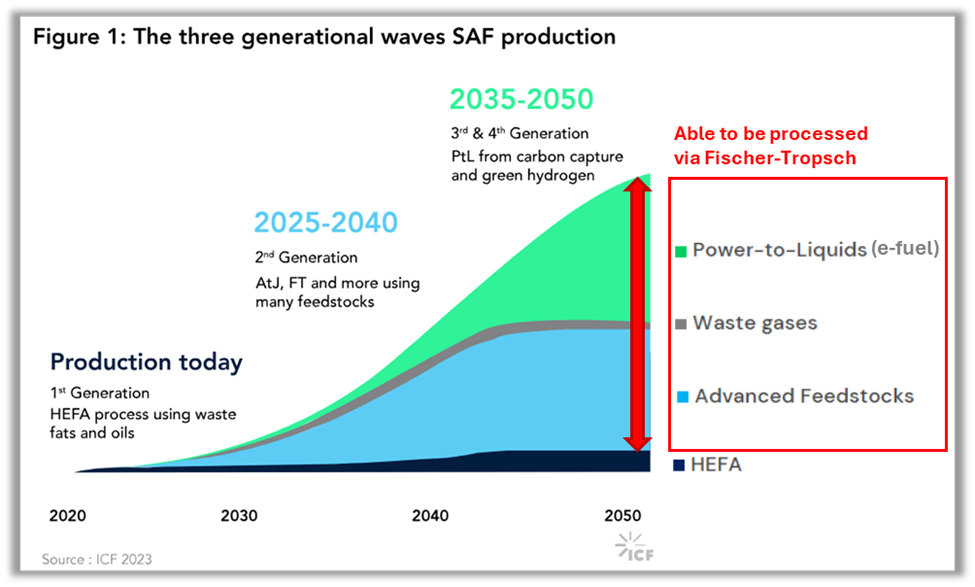
Advanced feedstocks: agricultural and forestry waste, organic commercial and household waste, municipal solid waste — can all be turned directly into syngas via processes including gasification, pyrolysis and steam reforming (and combinations thereof). Through anaerobic digestion, the same feedstocks can be converted to biomethane (and useful byproducts such as organic fertilizers), which is then reformed into syngas. The FT process then converts that syngas to fuel. There are other pathways to turn biomass into liquid fuels, such as Alcohol-to-Jet (AtJ), but none are as mature as FT. There is a single commercial AtJ plant constructed, but it has still not been fully commissioned more than a year after its official opening. “Alcohol” in this context refers to ethanol, which is produced at scale and often blended into gasoline. Somewhat confusingly, methanol is also a type of alcohol but has a different pathway to turn into jet, which is less developed and has not yet been approved for SAF production. Rather than “AtJ” we should be saying either “EtJ” or “MtJ” depending on the feedstock.
Power-to-Liquid (e-fuels): water is split by electricity (electrolysis) into oxygen and hydrogen; CO₂ provides the carbon atoms, stripped of one oxygen atom via electrolysis or the Reverse Water Gas Shift reaction (CO₂ + H₂ → CO + H₂O). The directly competing pathway is making methanol from syngas and converting it to jet fuel, once it is approved. AtJ also offers a potential path to convert CO₂ and hydrogen to fuels by first turning these feedstocks into synthetic ethanol.
The section above described many different ways to make syngas from many different feedstocks. While FT itself is mature, the different processes to turn biomass into syngas are less so and are the focus of much investment. This creates what I call the FT Funnel.
There are many dozens of companies focused on making syngas and its precursor processes — representing hundreds of millions of dollars in investment. Sitting above the “Power-to-Liquid” part of the funnel are many dozens more companies, with billions invested, to make hydrogen from water and to capture CO₂ (whether from industrial waste gases or from the atmosphere via Direct Air Capture).
And yet — there is only a single-digit number of credible providers of Fischer-Tropsch technology. Hence the funnel.
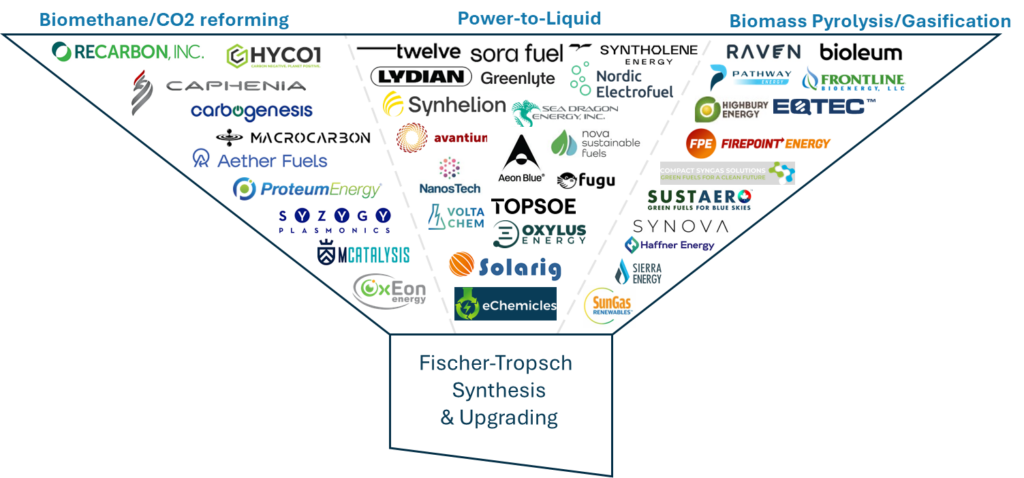
It is a bit misleading for companies with technologies that only produce syngas to call themselves “sustainable fuels companies” despite having no FT technology to turn that syngas into raw hydrocarbons, let alone the technology to upgrade those hydrocarbons into finished fuel. Although there are also companies such as Twelve that have used their own technology (and that of my company) to develop sustainable fuel projects.
There is only a handful of companies that have a complete proprietary technology stack to take feedstock all the way through syngas, FT synthesis, and upgrading to finished fuel. There are also attempts to merge some of these technology steps. But in the vast majority of cases, there are many points of integration required — which often fall to the FT technology licensing companies such as EFT to optimize and resolve.
That’s enough to get us started.
Next edition: we look at upgrading (turning FT output into finished fuel) and explore some surprising emerging applications for FT beyond renewable fuels — including one that puts FT right at the heart of the AI data centre boom.
If you found this useful, please share it with colleagues in the SAF and renewable fuels space. And I’d love to hear from you in the comments: what’s your biggest misconception about Fischer-Tropsch that you’ve encountered — from investors, developers, or policymakers?