


Immersion Cooling Technology for Data Centers
This is Edition 2 of a series on Fischer-Tropsch technology for non-technical audiences — investors, developers, and stakeholders in renewable fuels. If you missed Edition 1, it covered the basics of how FT works, its history, and why it matters for SAF. I’m David Lloyd, CCO of Emerging Fuels Technology (EFT), which licenses FT and Upgrading technologies.
Here’s something that will surprise most people outside the renewable fuels industry: SAF made via Fischer-Tropsch is completely clear and nearly odourless. Hold it next to fossil jet fuel, and the difference is striking. That purity is both FT’s greatest asset and one of its more interesting complications — and it’s also why FT products are finding lucrative new markets far beyond aviation, including powering the AI data centre boom.
This edition covers the Upgrading process that turns raw FT output into finished fuel and then takes a detour into some surprising applications that are rapidly becoming significant markets in their own right.
Anyone who has handled FT products such as SAF or Renewable Diesel will immediately notice they are colourless and almost odourless, while fossil jet and diesel are typically colourless to light amber and distinctly pungent. The reasons for Fischer-Tropsch fuels having less colour and odour are the lack of impurities and contaminants (such as sulfur compounds) that cannot be fully refined out of crude oil-based products.
One impurity is a type of hydrocarbon called aromatics, which (as the name implies) give off smells and are one of the reasons fossil fuels tend to “gum up” over time.
This purity has real advantages which we will get to. But it creates one notable complication: aromatics are necessary for the elastomeric seals in older jet engines to swell and seal correctly. Without them, seals can shrink and leak. This is the primary reason SAF is currently required to be blended with conventional fossil jet fuel — to maintain “backwards compatibility” with the existing fleet. (Higher blend limits are an active area of work in aviation standards bodies, and my own company is developing a process to take some of our byproduct to turn into aromatics to avoid blending altogether.)
There’s another purity-related issue. As we saw in Edition 1, FT hydrocarbons have carbon atoms arranged linearly — “straight-chain paraffins.” This makes longer-chain molecules susceptible to solidifying at low temperatures, which is obviously a problem for jet fuel and also diesel in cold conditions. Think of paraffin wax candles: solid at room temperature, liquid near a flame. In fact, one FT company sells surfboard wax straight out of its reactor. The upgrading process corrects this solidification problem for jet fuel.
One more piece of context before we get to upgrading. In Edition 1, we noted that the distribution of hydrocarbon chain lengths is determined largely by the catalyst and operating conditions. The specific property that governs this distribution is called alpha (α). Separately to this general distribution, there are other factors at work that determine how much additional methane (n=1) is produced. This is referred to as “methane selectivity,” which will be returned to in future editions because it’s something to be avoided in the context of FT because we want to produce waxes and liquids – not light gases.
Below is an example of a distribution of carbon chain lengths (“carbon number” or “n” on the horizontal axis) where the “alpha” is 0.85, which is at the low end for cobalt-based FT catalysts.
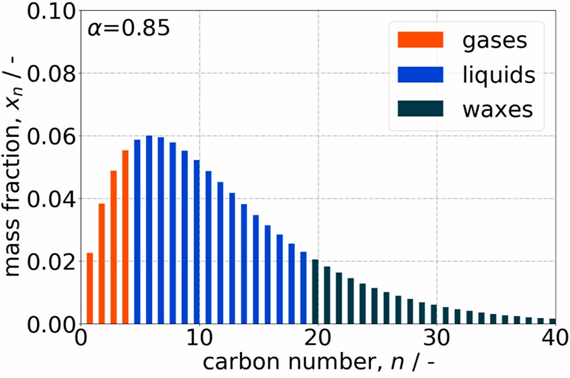
A high alpha means the reaction tends to produce longer chains; a low alpha means shorter chains. But regardless of alpha, what comes out of an FT reactor is always a soup of different chain lengths, ranging from 1 carbon atom (methane) to potentially over 100 — all of which need to be separated, reshaped, and refined to make useful products. That process is Upgrading.
Alpha is a critical consideration in FT technology design that we’ll return to in Edition 4.
Upgrading in the context of FT does three things:
1. Hydrocracking — “cracks” the longer carbon chains (the waxes) into shorter chains in the desired liquid fuel range, using hydrogen, heat, pressure, and a cracking catalyst.
2. Isomerization — alters the structure of straight chains (adding branches) to reduce their freezing point. This is done by passing hydrocarbons over a specialized catalyst with heat and pressure.
3. Fractionation (Distillation) — sorts the resulting hydrocarbons into groups by boiling point range, separating out naphtha, jet, diesel, and other products.
All of this can be done in a highly targeted way to maximise the yield of the desired products. FT hydrocarbons don’t need to be cleansed of impurities the way crude oil does — there’s no sulfur to remove, no heavy metals — but they do need to be separated and structurally adjusted.
Different catalysts and operating conditions produce different alphas and therefore produce different carbon chain distributions, which in turn affects how much of each product you end up with after upgrading. But it is also key to match the properties of the upgrading solution with that of the FT alpha. This is one of the key commercial decisions in technology selection and underscores the importance of integrated design rather than trying to “shotgun marry” different technologies.
Here’s where things get interesting for anyone thinking about the full commercial picture of FT.
Lubricating oil base stock
For most of automotive history, lubricating oil came from crude oil. But mineral base oils have real limitations: variable composition depending on crude source, wide spreads of molecule sizes, aromatics and sulfur compounds and other impurities that oxidize at high temperatures causing sludge and acid formation, and poor viscosity stability across temperature extremes.
Synthetic lubricants were developed — first for aviation in WWII, then commercially with the introduction of Mobile One in 1974. Gas-to-Liquid (GTL) base oils are a particularly elegant solution: natural gas (methane) is converted to syngas, and FT assembles pure long-chain hydrocarbons from scratch rather than extracting and refining them from crude. These can then be further tailored through isomerization. Shell’s Pearl GTL plant in Qatar — before the March 2026 damage — was the world’s largest production site for FT synthetic oil base stock, a role it has held since 2011.
Transformer oils
The oil inside transformers serves critical functions: insulating between energized components to prevent arcing, cooling by transferring heat, and protecting the paper insulation around windings (which is actually the life-limiting component). GTL transformer oils align extremely well with these requirements — high dielectric strength, excellent oxidation resistance, strong thermal stability — and sell at a significant premium over conventional mineral transformer oils.
The market is growing strongly, driven by grid modernization and renewable energy infrastructure investment – and of course the exponential growth of AI data centres. The US transformer oil market alone is valued at approximately USD 480 million in 2024, projected to reach USD 870 million by 2034. Global market size is several billion dollars.
AI data centre immersion cooling fluids
This is the most exciting emerging market — and it connects FT directly to the AI investment boom.
Data centres cool their server racks in one of two ways. Two-phase cooling uses fluorocarbon/ perfluorinated fluids (PFAS) that boil at low temperatures to absorb heat. If you haven’t encountered the PFAS reputational and regulatory crisis, a quick search will explain why this category is under enormous environmental pressure. Single-phase cooling keeps a liquid circulating continuously through heat exchangers, and this is where FT products shine.
The three main single-phase cooling fluids are mineral oil (from refined crude), synthetic GTL oil, and bio-based/natural esters. GTL synthetic oils are generally highest performing for the same reasons they excel as lubricants and transformer oils. Bio-based fluids are gaining ground driven by sustainability mandates.
Now here’s the thought experiment for investors. You know from Edition 1 that FT can take biogenic feedstocks (biomass, biogas, municipal solid waste) and renewable electricity and turn them into SAF. You also now know that FT produces hydrocarbon chains longer than jet or diesel range — chains that are ideal for immersion cooling fluids. And FT from natural gas is already producing those fluids commercially at Pearl GTL.
So why not make immersion cooling fluids from renewable feedstocks via FT to reduce its emissions footprint to meet sustainability goals?
It’s already happening. At least one company (Infinium, using Power-to-Liquid) is offering immersion cooling fluids from renewable electricity and CO2 feedstock. The same product could be made — at much lower cost — using biogenic feedstocks.
The data centre immersion cooling market was valued at approximately USD 4.9 billion in 2025 and is forecast to reach USD 11.1 billion by 2030. And many data centres also run diesel generator backups — making them significant Renewable Diesel consumers. Here, the purity of FT products we talked about earlier also gives longer shelf life – another win.
FT benefits from the AI boom in three different ways simultaneously – in the electricity infrastructure, in cooling, and as backup fuel. Not bad for a 100-year-old technology – Fischer and Tropsch would be proud to see how their baby has grown up.
In Edition 3, we explore the major types of FT technologies. We’ll look at their relative strengths and weaknesses — here’s where things get interesting.
What’s your reaction to FT products showing up in AI data centres and electricity grid transformers? Does this change how you think about the investment case for FT-based renewable fuel projects? I’d genuinely like to know — comment below.