


Widebody vs Narrowbody: Bigger isn’t Better
This is Edition 4 of a series on Fischer-Tropsch technology for non-technical audiences — investors, developers, and stakeholders in renewable fuels. Editions 1–3 covered the FT process, upgrading, new applications, and the three main FT technology types. I’m David Lloyd, CCO of Emerging Fuels Technology (EFT), a leading licensor of FT and upgrading technologies. EFT works with Multi-Tubular Fixed Bed technology, which is the subject of this edition.
Declaration of interest: I’m going to use EFT’s own execution as examples throughout this edition. The general principles apply to Multi-Tubular Fixed Bed as a technology class — but they don’t happen automatically, and EFT’s choices are the ones I have at hand.
In Edition 3, I made the case that Multi-Tubular Fixed Bed is the most commercially flexible FT technology — being the basis for both the world’s second largest and some of the smallest commercial FT plants. At the scale of renewable fuels projects, it is also lowest capex cost for the FT island, independently of the upstream syngas and downstream upgrading islands. But within the Multi-Tubular Fixed Bed FT universe there are different ways to design and build the technology. And different executions of the same basic technology can sit on fundamentally different cost curves – meaning it is possible for a smaller plant to be lower unit cost than a larger one.
That matters enormously for anyone evaluating a renewable fuel investment that is below the scale of traditional oil and gas.
“Bigger is better” is so deeply ingrained in the oil and gas industry that the assumption is rarely examined. And historically, for large stick-built Gas-to-Liquid plants using Fischer-Tropsch technology, it has held: capital intensity (capex per barrel of capacity) falls as plant size increases. This is well documented for conventional GTL plants with natural gas feedstock, and the data points track the expected curve — Shell Pearl, Oryx, Escravos, and others.
But a closer look at those data points reveals something important: those plants were all built using the same design and construction philosophy — custom-engineered, site-specific, “stick-built” in the field. The cost curve they follow is real, but it is the cost curve for that design and construction method. It is not the only cost curve available.
Here’s the insight that is often overlooked: different process design, mechanical design and construction philosophies produce different cost curves. They are not variations of the same curve — they are structurally distinct.
To make this concrete, and extending an analogy used in the previous edition of this newsletter, the aviation industry offers a great parallel. Widebody aircraft (such as the A330, B787, A380) have a particular operating cost per seat-mile curve. Smaller narrowbody aircraft (the B737, A320) have a different cost curve. On short to medium routes — up to roughly the limit of narrowbody range — narrowbodies have lower cost per seat-mile than widebodies. Not because they are a cheaper version of the same thing, but because they were designed for a different job. Here’s what it looks like:
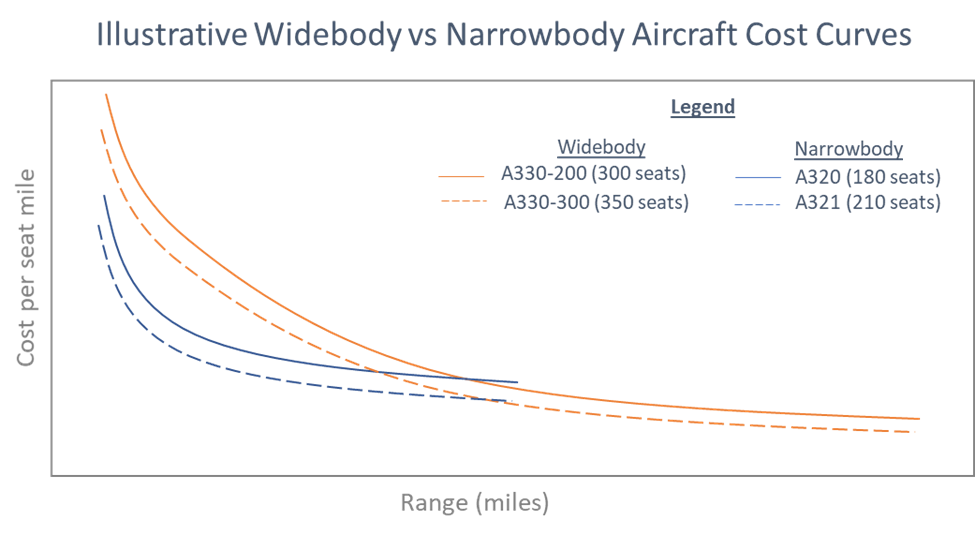
Low-cost carriers like Southwest, Ryanair, and EasyJet figured this out decades ago. None of them operates widebodies on short routes (no airlines do this any longer except in special circumstances). The narrowbody has lower total cost for its target application because it carries a lighter fuel load, has a lighter structure, has proportionally smaller engines, turns around faster between flights and the aircraft capex per seat itself. Within each curve, bigger is still better — larger narrowbodies are cheaper per seat than smaller ones. But the two curves don’t converge until surprisingly long distances where widebodies’ range advantage finally wins out.
The parallel with FT is that traditional large stick-built plants are the widebody aircraft. Within the stick-built GTL cost curve, bigger is better — and that curve is real for plants above the 10,000 barrels per day (BPD) range. But a Fixed Bed plant designed from the start for smaller-scale shop fabrication can occupy a different cost curve, like the narrowbody aircraft. At the scales relevant to renewable fuel projects — broadly 500 to 5,000 BPD — a well-designed modest-sized plant can achieve similar capital intensity to a bespoke stick-build of ten times its capacity.
That is not a marginal improvement. It is a structural advantage built into the process and manufacturing design philosophy.
First the bad news: there is no silver bullet. You can’t turn an A380 into a B737 by building the same thing only smaller. Some of the differences are in how the aircraft themselves are engineered, others in how their construction process is designed. The same is true here. Getting onto the lower cost curve requires a set of interlocking choices about reactor size, sub-system design, and manufacturing approach — all made together, none of which would seem to make such a big difference in isolation.
I’m not going to give away all of EFT’s company secrets here, but I’ll use a few examples to illustrate what such interlocking choices look like in practice — and how the resulting plant differs from how traditional large-scale Multi-Tubular Fixed Bed projects are designed to get to the lower cost curve.
Two dimensions of “module”
Let’s start with how Multi-Tubular Fixed Bed actually scales — because it does so in two dimensions, not one, which gives it much more flexibility than the Microchannel and Slurry reactors critiqued in Edition 3. The first dimension is internal: each tube inside a reactor is itself a small module, like a single cell in an electrolyser or a single solar panel. To make a larger reactor, once you have co-optimised the tube dimensions for the catalyst, you simply add tubes (i.e. modules) and increase the diameter of the pressure vessel these tubes sit within — up to an optimum reactor size (equivalent to a stack size in an electrolyzer, or solar array). The second dimension is external: once you’ve reached that optimum reactor size, you scale further by adding reactors (i.e. modules) in trains, like stacks within an electolyzer installation or arrays within a solar farm. You now see the irony in Microchannel’s puffery about being “modular”.
The trick is finding that optimum reactor size — and it tends to be a function of the manufacturing system rather than anything inherent in the actual reactor design, which in isolation will always favour going larger. Below the optimum, adding tubes inside one reactor is cheaper than building a second reactor. Above it, as you hit some key inflection points, the manufacturing economics flip — adding identical reactors in a train becomes cheaper than growing the single reactor further. Adding a train of identical reactors is not a new engineering problem; it is the same engineering problem solved again, with learning effects that reduce cost with each iteration. Several standard reactors operating as a train can therefore achieve lower total capital intensity than a single bespoke reactor of equivalent capacity, up to somewhere likely in the 5,000–10,000 BPD range – well above the size of most feasible renewable projects currently in development.
Pick the size the materials and logistics already want you to pick
So where does that optimum reactor size actually sit? Well, for a Multi-Tubular Fixed Bed reactor for an EFT reactor tube, several material and logistics thresholds cluster around the twelve-foot diameter mark. This confluence is often overlooked, particularly by large companies that have separate departments for process design and construction design. At this point, the tube sheet — the thick plate at each end of the reactor through which the tubes are mounted and makes all the tubes (modules) function as a unit — exceeds around four inches in thickness, beyond which it can no longer be fabricated from standard plate steel and requires a custom forging. Custom forgings are dramatically more expensive, have lead times measured in months, and above certain diameters can only be sourced from two countries in the world. It would be madness to only just exceed this threshold and incur the step change in cost.
Twelve feet also happens to be about the maximum width that can be transported down a US highway as a standard wide load without escort cars and additional permitting requirements. Below this size, a complete reactor mounted on a skid can be fabricated by almost a hundred workshops in North America alone and trucked anywhere. Around 12-feet diameter is also a size that can be handled by a standard commonly-available 200-ton crane to erect the reactor skid (the heaviest unit in an FT island) into place.
So the optimum reactor size is not arbitrary: the materials and the logistics tell you what it is. EFT designs its FT reactor up to the twelve-foot threshold (equating to approximately 1,000 BPD capacity) for exactly this reason. This isn’t a theoretical inflection point — EFT has received competitive quotes for reactors both below and above the key diameter, showing that the cost per unit of production is very effective at this scale.
Combine and simplify sub-systems
While it is possible to build a smaller FT island with all the same components of a large system, this keeps you on the same cost curve. This is why you don’t ask a big company to build a small FT system. Back to our aircraft analogy, crew rests for pilots and cabin crews in widebody aircraft are their own compartments which integrate unique environmental control systems (separate air conditioning and oxygen hookups), customized acoustic and thermal insulation, customized communication panels (aircraft interphone), emergency lighting, and dedicated smoke detection and fire suppression systems that are integrated into the aircraft’s master avionics. In a narrowbody the crew rest is a passenger seat. Let’s have a look at a few examples of simplification when you are striving to make a modest sized FT island as a small company with a blank slate.
Thermosyphon cooling. As described in Edition 3, EFT’s reactor is cooled by a thermosyphon — water boils against the reactor tubes, steam rises, condenses at the top, falls back, and the whole loop circulates itself with no pumps. No forced circulation means no pump capex, no electricity to drive pumps, no pump maintenance. The catch is that this is most efficient within a certain range of reactor sizes (and doesn’t work at all at microchannel size). The ten to twelve-foot reactor scale diameter works very well with the thermosyphon. It is also large enough to recover heat efficiently.
In-situ catalyst regeneration. FT catalysts need periodic regeneration to restore activity. Large slurry plants extract the slurry and regenerate the catalyst in dedicated equipment; many large multi tubular fixed bed designs treat regeneration as a separate sub-system. EFT’s catalyst can be regenerated inside the reactor, leveraging a compressor used by another subsystem, without removing the catalyst. The compressor is doing two jobs instead of one, and because regeneration is needed only approximately annually, downtime is limited. Recall in Edition 3 that balance of plant is a killer for Microchannel – this regeneration and the thermosyphon are examples of simply doing away with such items.
Stacked-bed hydrocracker / isomerization. In a conventional refinery, hydrocracking and isomerization happen in two separate high-pressure reactors with their own ancillaries. EFT’s patented design stacks catalyst beds inside a single lower-pressure vessel. The result is fewer vessels, lighter-duty equipment throughout, and lower energy consumption. The same simplification principle as the in-situ catalyst regeneration: where one piece of kit can do two jobs well at the requisite scale, combine them.
The thread tying these together is that larger plants almost always separate functions into dedicated sub-systems. A company focused on a smaller size is incentivized to do the opposite: combine functions, dual-use equipment, and quietly remove whole sub-systems and achieve radical simplification and capex reduction. Not just building a smaller version of a big plant.
Shop-build, not stick-build
Because the reactor stays below key logistic thresholds, fabrication can move out of the field and into the shop. Massive oil-and-gas-scale stick-built plants require gathering large amounts of highly skilled labour at the project site — sometimes in remote locations, sometimes requiring temporary construction villages. Weather dependency, travel costs, and the inherent inefficiency of building a one-off structure in the field all add cost. A shop-built plant, by contrast, is fabricated in a controlled workshop environment, factory-acceptance-tested before shipping on skids, and just erected on site. Field labour — particularly welding, insulation, and instrumentation work — is the most expensive and weather-sensitive part of any construction project. Moving it into a shop reduces both cost and risk. Typically, a shop-built facility can be assembled in the field two to three times faster than a comparable stick-build, and with the right design at the right scale, many shop-built trains can be delivered for less than the cost of stick-building the same capacity on site.
Design once, build many — with one organisation accountable
Stick-built GTL plants have been one-offs with a single exception. Designing a new plant from scratch each time means the engineering cost is borne entirely by that project, and there is no learning curve in construction from one plant to the next – in fact construction of the GTL “copy” referred to above was a fiasco costing ten times the original. The shop-fabricated approach inverts this: design once, build many. Engineering costs are amortized across multiple plants. Each successive build is faster and cheaper. Because the reactor sizes stay below key thresholds and are easily transported, fabrication can be competitively tendered across hundreds of workshops worldwide, with no requirement for specialist facilities.
EFT layers one further simplification on top: it can leverage an integrated manufacturer model rather than the traditional chain of EPC contracting. In the conventional model, an owner contracts an engineer, who may contract a procurement firm, who contracts a construction manager, who contracts several fabricators — each layer adding cost, risk, and the potential for blame-shifting when things go wrong. A single integrated manufacturer covering engineering, procurement, fabrication, and construction delivers one risk profile, one cost structure, and a firm delivery commitment. This is only possible when the technology is mature enough, the design standardized enough, and the overall capex/size small enough to support it. For EFT, these conditions are met.
The practical upshot is that a renewable fuel project in the 500–5,000 BPD range — which describes almost every biogas-to-SAF, biomass-to-liquid, or waste-to-fuel project currently in development — does not need to accept being stuck on the capex cost curve of a traditional stick-built plant. A Multi-Tubular Fixed Bed plant deliberately sized, designed and manufactured around the cluster of simplifications described above can achieve capital costs competitive with plants an order of magnitude larger.
This is the economic case for Fixed Bed FT at renewable scale. Not just “it works at this size” — but it is structurally cheaper at this size than any alternative design philosophy.
Coming Next
Edition 5 will go deep on catalyst strategy — specifically, what high-alpha catalysts are, why catalyst choice determines the entire shape of a plant’s economics, and how matching catalyst alpha to upgrading design can significantly reduce costs both in upgrading and also upstream in syngas production.
Has the “bigger is better” assumption shaped how you’ve thought about FT project economics? I’d be interested to hear whether this reframes the investment case for you — comment below.

Leave a Reply
You must be logged in to post a comment.