

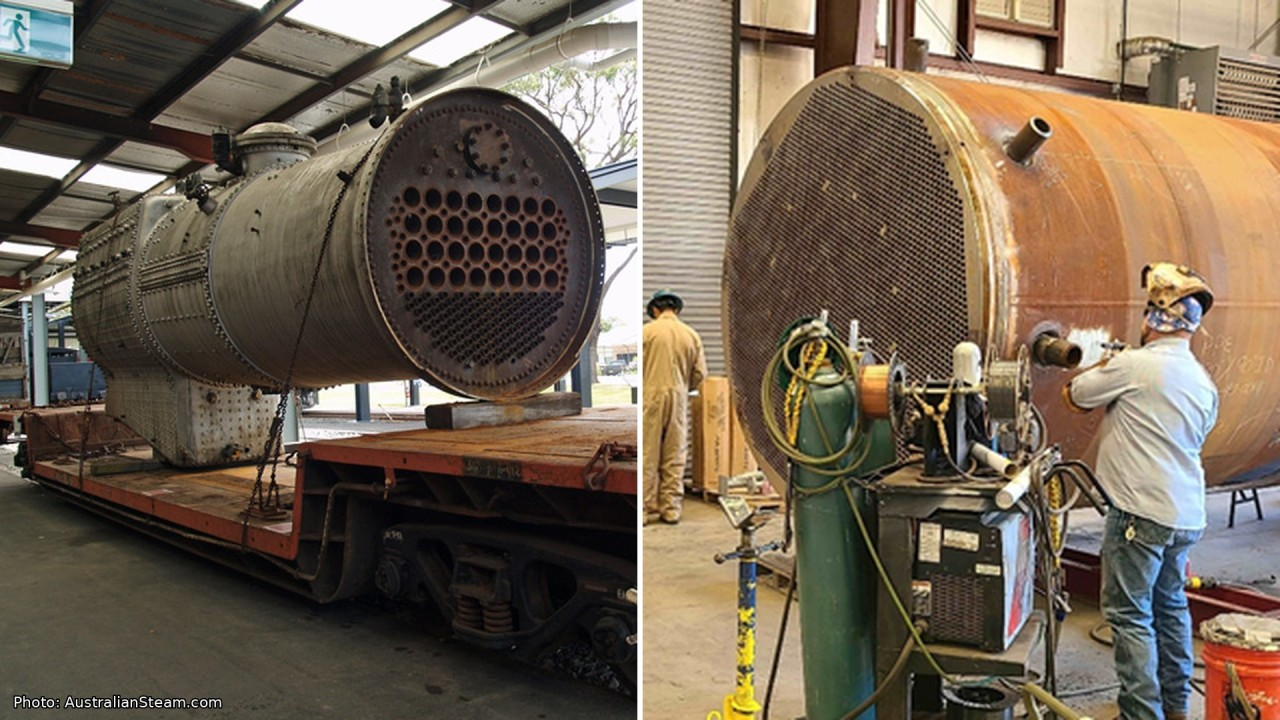
One of these is a steam locomotive boiler — a design that dates back to 1829. The other is the heart of a 2029 SAF plant. More in common than you may think.
This is Edition 6 of a series on Fischer-Tropsch technology for non-technical audiences — investors, developers, and stakeholders in renewable fuels. Earlier editions covered the FT process, upgrading, emerging applications, the three main FT technology types, the economics of small-scale Fixed Bed FT, and why catalyst and upgrading must be designed together. I’m David Lloyd, CCO of Emerging Fuels Technology (EFT), a leading licensor of FT and upgrading technologies.
Declared interests: EFT designs and licenses Multi-Tubular Fixed Bed FT — the technology this edition defends. This one is more opinionated than most. You’ve been warned.
I recently spent an afternoon in a railway museum and found myself standing in front of the boiler of a steam locomotive with a sense of déjà vu. A cylindrical steel shell. A flat plate at one end — the tubesheet — drilled with rows of holes. Through each hole, a tube running the length of the boiler.
I’d seen it before. Not in a museum, but in a fabrication shop where an EFT Fischer-Tropsch reactor was being built. Same shell. Same tubesheet. Same forest of tubes — in our case, thousands of one-inch diameter tubes, each of which will be filled with catalyst.
The similarities are not just appearances. Both are shell-and-tube heat exchangers, and both make steam on the shell side between the tubes. In a locomotive, hot gases from the firebox race through the tubes and boil the water surrounding them; the steam drives the pistons. In an EFT reactor, the Fischer-Tropsch reaction releases heat inside the catalyst-filled tubes and boils the water surrounding them; the steam carries that heat away — circulating itself by thermosyphon, as described in Edition 3 — and is put to work elsewhere in the plant.
So, the heart of a 21st-century synthetic fuel plant is, quite literally, Victorian technology. I think that is its greatest strength.
In 1829, Stephenson’s Rocket won the Rainhill Trials. Its decisive innovation was a multi-tubular boiler — 25 copper tubes carrying hot gas through the water, instead of a single large flue. That idea went on to power the railways of the world.
Over the following century, the shell-and-tube design spread from locomotives to ships, power stations, and eventually every refinery and chemical plant on earth. Along the way it accumulated an enormous body of knowledge — some of it very hard-won. A string of deadly boiler explosions in the late 19th and early 20th centuries led to the first edition of the ASME Boiler and Pressure Vessel Code in 1914. That same code, much evolved, governs the design and fabrication of EFT’s FT reactors today. In 1941, the Tubular Exchanger Manufacturers Association (TEMA) published its first standards, codifying how tubes are fixed into tubesheets, how shells are dimensioned, and how the whole assembly is tested.
The result is an industrial ecosystem that is almost invisible because it is everywhere. There are hundreds of ASME-certified fabrication shops across the US that build shell-and-tube equipment as a matter of routine. Their welders, inspectors, and quality managers have done it thousands of times. Nobody needs to be taught how to build one of our reactors.
A while ago I was pitching to a VC. Partway through, they leaned back and asked, with a hint of a smirk, whether Fischer-Tropsch wasn’t “100-year-old technology.” They were looking for breakthroughs, they explained, and FT didn’t look like one.
They were right about the date. Franz Fischer and Hans Tropsch patented their process in 1925. What the VC apparently hadn’t considered is that Frank Whittle patented the jet engine in 1930. The jet engine is only five years younger than FT — and FT makes the fuel that jet engines burn. Synthetic paraffinic kerosene made by FT was the first synthetic jet fuel approved under ASTM D7566 in 2009. Our predecessor company Syntroleum made synthetic jet fuel that was test-flown by the USAF in a B-52 bomber 3 years earlier.
Nobody looks at a modern turbofan and dismisses it as 1930s technology. Both have spent nearly a century in continuous improvement. FT went from 1930s Germany, to Sasol’s fixed-bed Arge reactors in 1955, to Shell’s Bintulu plant in 1993 and Pearl GTL in 2011, and now to the small-scale renewable plants this series has been about.
An old principle is not the same thing as an old execution. And in industrial technology, a long track record isn’t a weakness to apologise for — it is the asset.
Here’s what the VC missed. In renewable fuels, the hard problem usually isn’t proving that the chemistry works. It’s building a plant on time and on budget, financing it, and running it reliably for twenty years. Industrial maturity addresses every one of those risks.
Fabrication. When hundreds of shops can build your reactor, you get competitive bids, realistic schedules, and no single point of failure. If one shop is full, another can take the job. A reactor that only one or two shops in the world know how to build is a schedule risk and a pricing problem waiting to happen.
Codes and inspection. Lenders’ independent engineers, insurers and regulators already know ASME and TEMA equipment. They know what a code stamp means and how to inspect against it. A novel reactor needs novel inspection regimes — and everyone in the financing chain charges for the time it takes them to get comfortable.
Balance of plant. The reactors are only part of the plant, and not the most expensive part. The rest is pipes, pumps, compressors, valves, heat exchangers, instruments, and control systems. In a Fixed Bed FT plant, these are garden-variety oil and gas equipment, found in every refinery and petrochemical plant in the world, with catalogue part numbers, vendor support and spares on the shelf. That isn’t always true of the plant built around a proprietary reactor, which can force bespoke equipment well beyond the reactor itself — as Edition 3 discussed for Microchannel.
People. An operator or maintenance technician from any refinery can walk into an EFT plant and recognise almost everything they see.
Cost of capital. Add all of that up, and you arrive at what matters most to project economics: risk, priced. Lenders charge a premium for novelty — through higher interest rates, larger contingencies, tougher completion guarantees, or by simply declining. Mature hardware narrows that premium.
The contrast with proprietary reactor designs is stark. Microchannel reactors have few experienced fabricators and no commercial-scale track record. Slurry is mature at oil and gas scale, but its hydrodynamics don’t scale linearly, so each new size is effectively a first-of-a-kind (Edition 3), and it is particularly tricky to operate at small scale. EFT may be the only company in the world to have built and operated both slurry and fixed-bed FT at the same scale. Neither Microchannel nor Slurry has anything like two centuries of shell-and-tube practice, plus a century of oil and gas equipment, behind it.
To be fair to the VC, there’s a sharper version of their question, and it deserves an answer: if any competent fabrication shop can build your reactor, where’s your intellectual property?
The answer is that the hardware is commodity on purpose. EFT’s differentiation lies in four places:
The steam era itself offers a good illustration. In the late 1920s and 1930s, the French engineer André Chapelon took existing locomotives — ordinary boilers, ordinary frames — and rebuilt them with redesigned steam passages, improved superheating and a better exhaust system. The results transformed their performance. His exhaust design, the Kylchap, was fitted to Mallard when it set the world speed record for steam of 126 mph in 1938 — a record that still stands. The boiler was never the secret. The secret was how the whole system was designed around it.
Commodity hardware with proprietary know-how is the best of both worlds: low technical and execution risk, plus a defensible position that you can’t see from the outside of the reactor.
Which brings me to the uncomfortable part. The VC’s instinct — that old means boring, and boring means uninvestible — isn’t unique to them. Parts of the venture world are drawn to breakthrough narratives: slick slide decks, bold claims of process intensification and order-of-magnitude cost reductions, technology that nobody else has. I suspect this VC would have been first in line for Theranos (great series now streaming!).
Theranos is remembered as a fraud, and it was. But the more useful lesson for investors is structural: the novelty that made the story exciting was the very thing that made it difficult to check and the fraud possible. Investors were asked to trust the story, and they did — to the tune of hundreds of millions of dollars. The irony was that Theranos used established technology to hide the non-performance of its own, and the misuse of those Siemens machines was central to how the deception unravelled.
Renewable fuels have their share of companies (across the feedstock processing, syngas and fuel synthesis and upgrading value chain) whose pitch rests on similar foundations. I’m not going to get into detail here for obvious reasons, and it’s not the point of the article.
Novelty itself isn’t the problem. Every mature technology was novel once — FT included. The problem is unverifiable novelty: claims that can’t be tested until hundreds of millions of dollars have already been spent. Promising lab results don’t always translate to industrial scale.
So here are a few questions I’d ask of any renewable fuels technology — ours included:
The locomotive I stood in front of will never turn a wheel again. But its boiler never really retired. Its descendants are at work in every refinery, power station and chemical plant on the planet — and now in plants making fuel for jet engines, a technology just five years younger than FT, and just as far from “old”.
The most radical thing in a SAF plant should be the fuel, not the hardware.
Have you seen a project where a “boring” technology choice saved the day — or where a breakthrough technology failed to deliver? I’d be interested to hear — comment below.

Leave a Reply
You must be logged in to post a comment.